
For parents of kids 3-8 with big feelings
Fifteen minutes a night that teach your child what to do with big feelings

- Tell Mishami what happened today. Your child becomes the hero of a story about that exact feeling.
- Riddles to solve together. Questions to talk about. A card with the words for you.
- One evening ritual. Fifteen minutes that end the day well.
THE CHALLENGES
When Feelings Get Too Big for Words
Every parent knows these nights. You're not alone, and there's a way through.

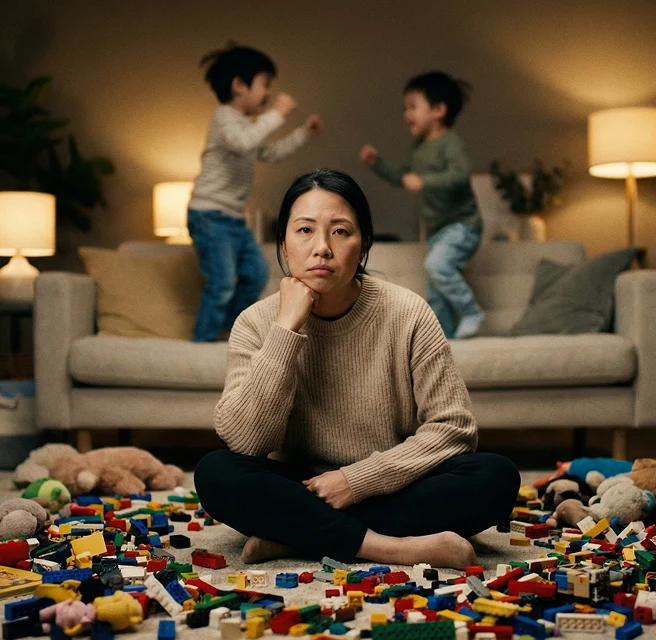
The Meltdown
"He goes from zero to sixty in seconds. Screaming over a broken cookie. Nothing I say helps."

The Bedtime Battle
"I dread the sun going down. What should take 10 minutes turns into an hour of tears."

The "Missing Words"
"I want to comfort her, but I freeze. I don't know what to say."

The Drop-Off Tears
"Every morning at daycare, she clings to my leg crying. It breaks my heart."

The Screen Guilt
"I hand over the tablet just to get 5 minutes of peace. Then I feel awful about it."
HOW IT WORKS
One Evening Ritual, Three Parts
One sentence from you. Fifteen minutes together. No parenting degree required.
STEP 01
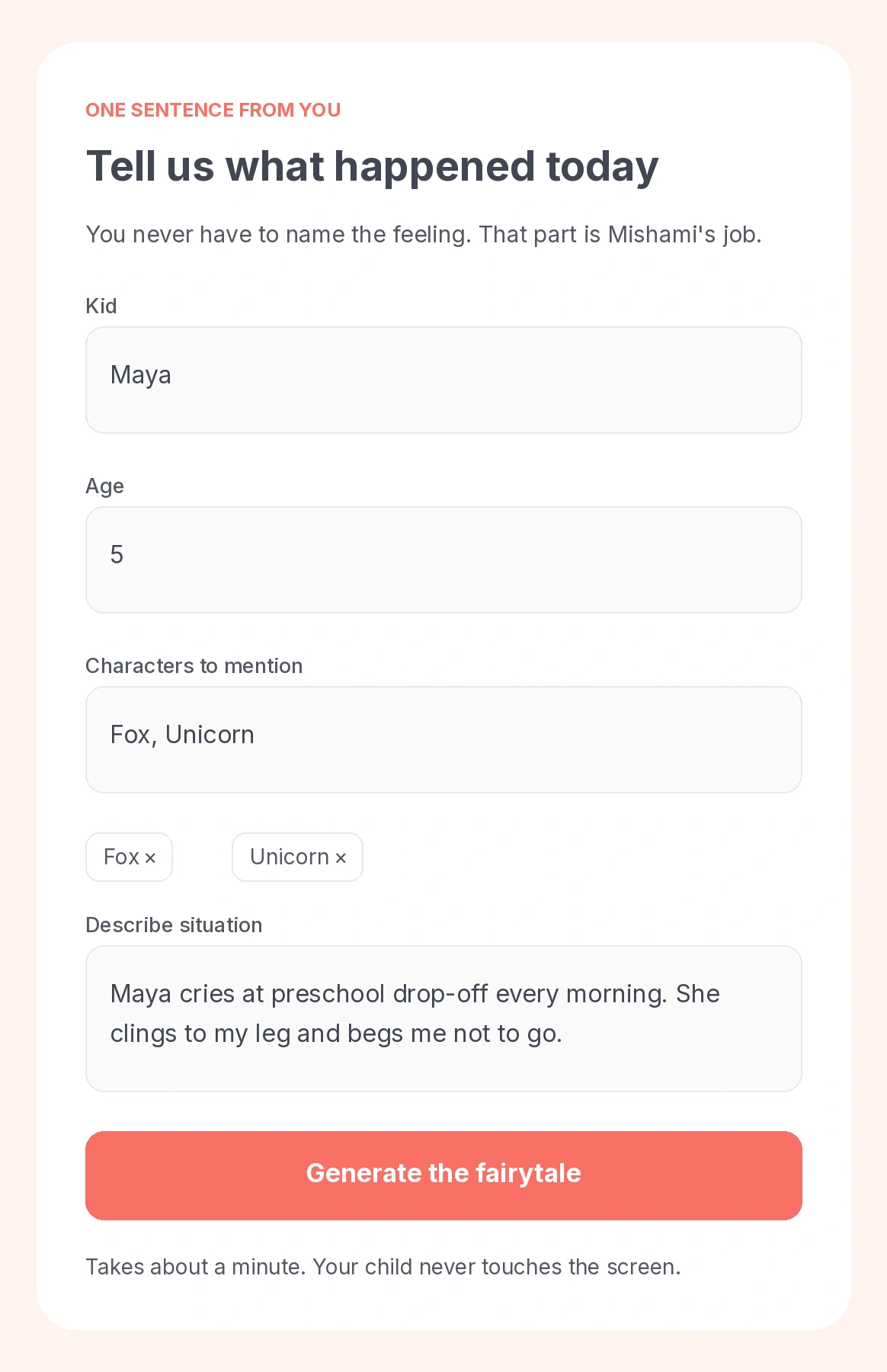
Tell Us What Happened Today
"Lily is scared of the dark" or "Jake hit his sister again." One sentence about your child's day. You never have to name the feeling. That part is Mishami's job.
STEP 02
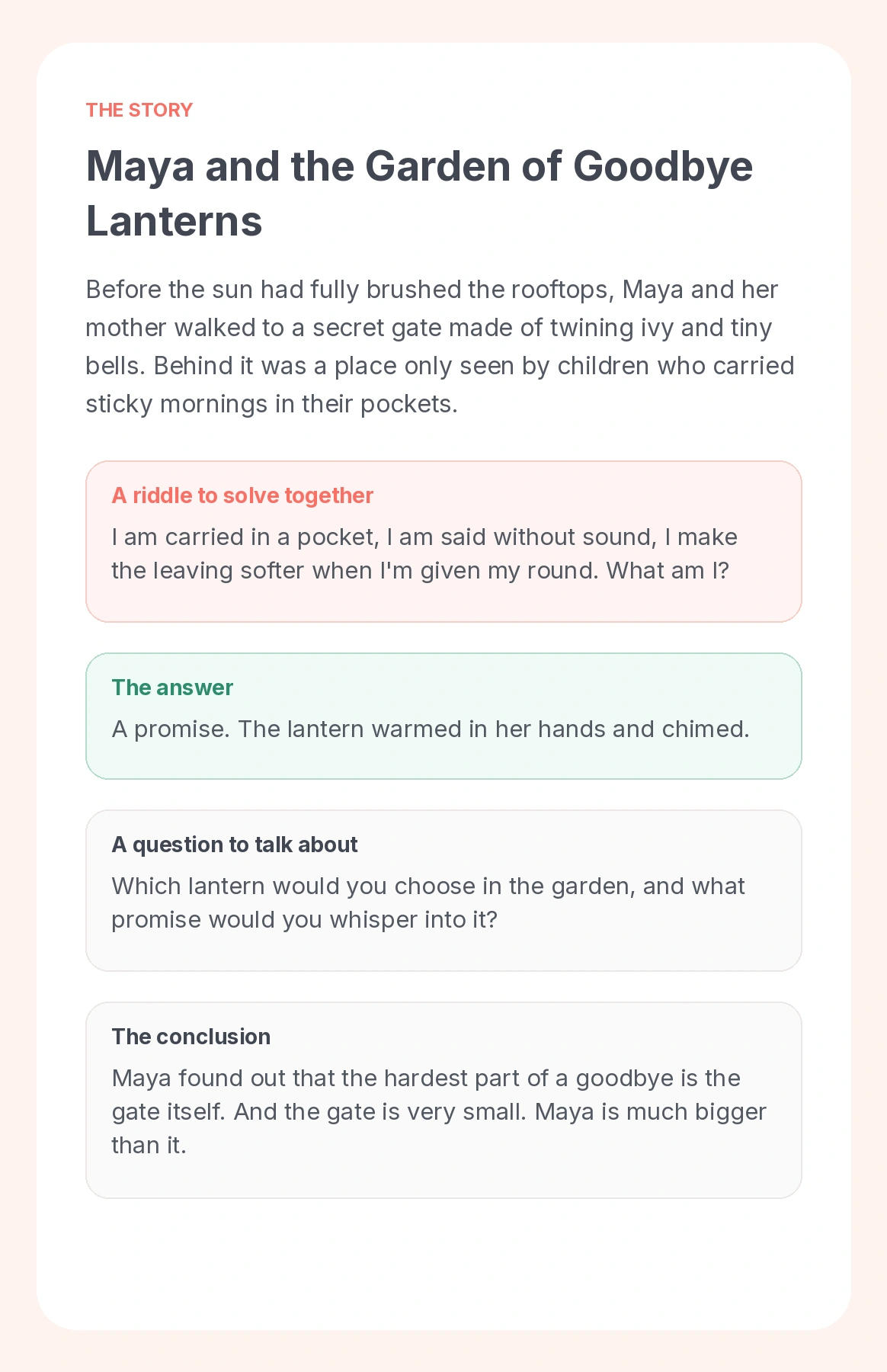
Read and Talk It Through
Your child stars in a story about that exact feeling, with riddles woven in to solve together, a gentle conclusion, and questions that start a real conversation. Not a lecture. A story they ask for again.
STEP 03
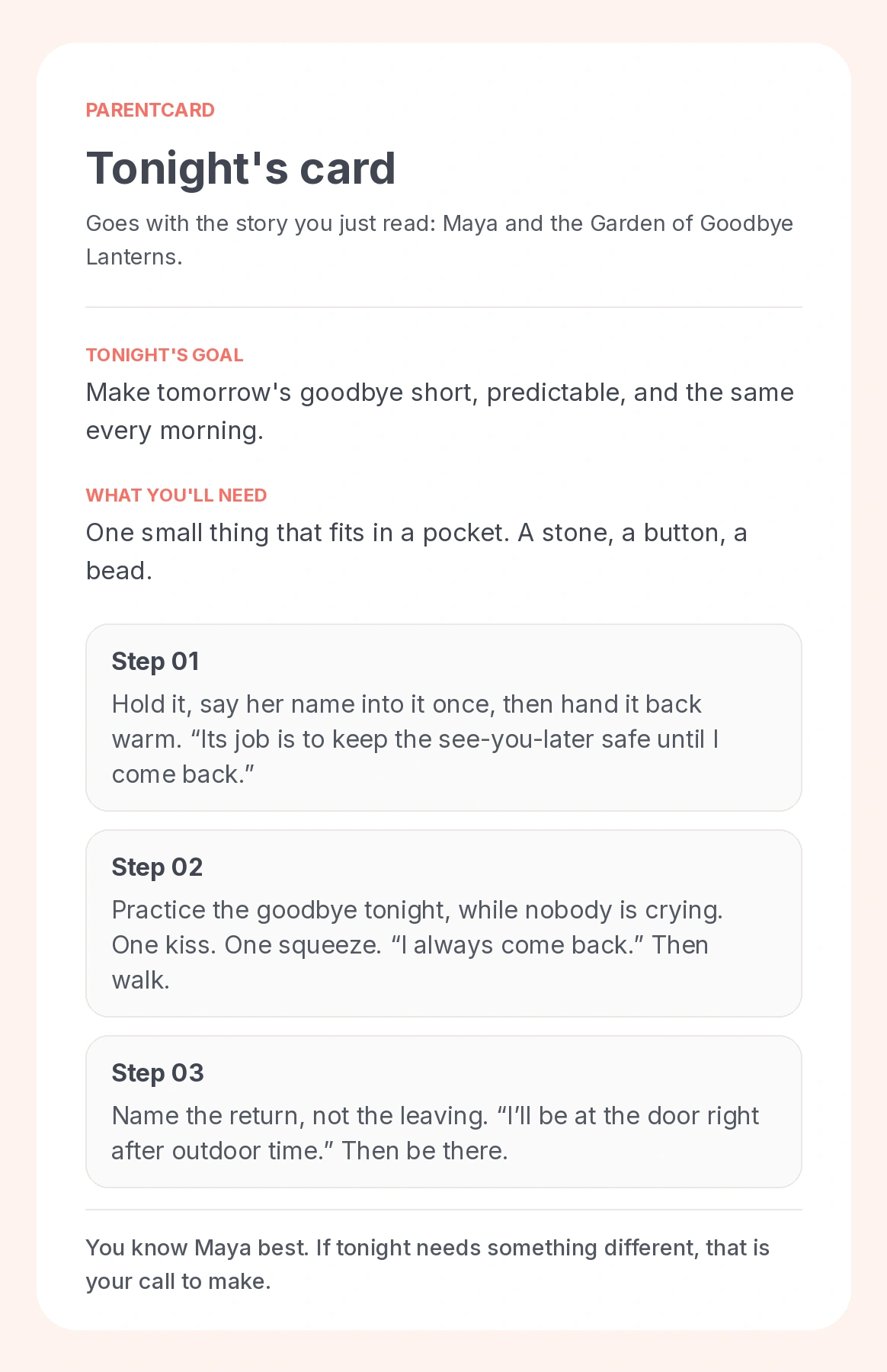
Get Your Card
What usually sits underneath a feeling like this. What usually doesn't help. Concrete steps for tonight, with the words to say. You know your child best. The card helps you use what you already know.
UNDER THE HOOD
Not a fairy tale generator. A frame with a story inside.
Ask a chatbot for a bedtime story and it writes one, then stops. Mishami is built differently, and the difference is the frame around the story. Here is what happens to your one sentence.
01
It reads the situation, not keywords
"She screams at drop-off" and "she's been quiet since the baby came" are different situations with different feelings underneath, and they need stories that do different work. Mishami works out what's underneath, so you never have to name it.
02
The story is built to a method, not to a blank page
Every story follows the same structure: the feeling met at a safe distance, riddles the child solves along the way, a conclusion in plain words, and questions that open a conversation instead of an interrogation. The method is reviewed by our clinical advisor, a medical doctor and psychotherapist.
03
Written for your child's age, by name
A four-year-old and a seven-year-old going through the same thing need different words, different sentence lengths, and different pacing. And the hero is your child, by name, with the characters they love.
04
The card is the other half
The story is for your child. The card is for you: what usually sits underneath a feeling like this, what usually makes it worse, and concrete steps for tonight with the exact words. That half is what parents tell us they were missing.
The story is the vehicle. The frame around it is what turns fifteen minutes of reading into a conversation your child remembers.
See a real exampleSAFETY
Built for Trust. Designed for Little Minds.
AI near children requires extra care. Here's how we earn yours.

Content Written for Ages 3 to 8
No violence. No ads. Nothing inappropriate. Every story is written for young children and checked before you see it.

You Read, Not a Screen
Mishami writes the story. You read it aloud. Your voice is the anchor, not a device. Your child never uses the app.

Reviewed by a Clinician
Our approach is reviewed by Elina Antonova, Medical Doctor and Psychotherapist, with more than 20 years of clinical and therapeutic experience.

Your Data Stays Yours
First name and age, nothing more. No photos of your child, no recordings. We don't sell your information, and you can ask us to delete everything at any time.
Mishami is not an emergency service and does not monitor for emergencies. If you are worried about your child's safety, contact your local emergency services or a qualified professional. Our Terms explain this in full.
FOUNDER
She's 3,000 km away. Stories keep us close.
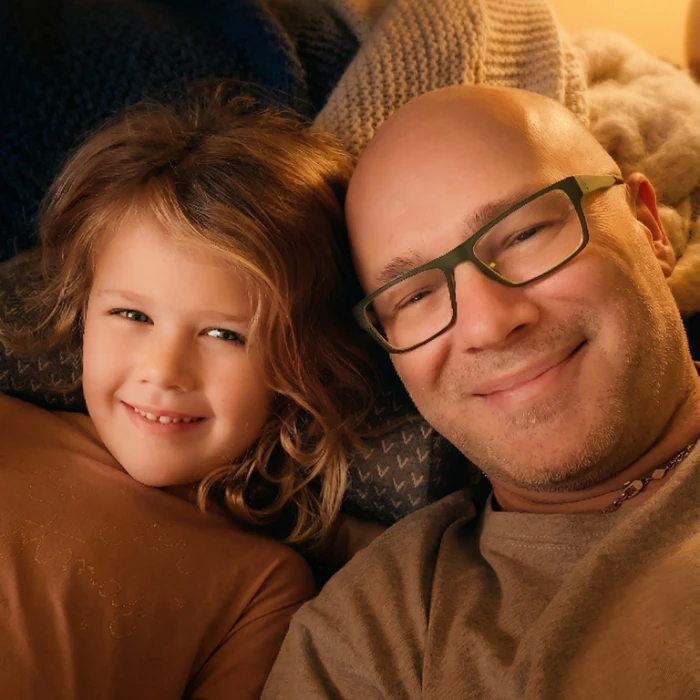
"After my divorce, Michelle stayed in Spain. I moved away.
Video calls replaced bedtime hugs. One night, when she was upset and I felt helpless from so far away, I made up a story about a brave girl named Michelle who faced the same problem.
She asked for another. And another. It became our thing.
That's Mishami: the stories that kept us connected when I couldn't be there to hold her. Now I want every parent to have the same tool."
Taras Kopytko, Michelle's dad. Building what I wish I'd had.

OPEN BETA
Built with real families, in the open
Mishami is in open beta. The first families are already using it for real bedtimes, real drop-off mornings, and real big feelings, and their feedback shapes every release.
We publish nothing invented here. No paid reviews, no stock-photo parents. As beta families agree to share their words, you will read them on this page, with their permission and nothing else.
“My wife and I made two stories for our daughter and read them to her. She didn't want to listen at first, then got completely pulled in. The riddles are her favorite part, she kept asking for more. She'd love it even more with pictures. We're subscribing and testing it for the full month.”
Dmitry, dad of a 4.5-year-old
Beta family. Translated from Russian.
THE SCIENCE
The conversation is the method. The story makes it happen.
Children build emotional understanding one way above all: by talking with a parent about what actually happened to them. This is one of the better-studied things in early childhood. A 2023 review of 15 randomized trials found that when parents learn to hold these conversations, their children's emotional understanding measurably grows.
Here is the honest problem. At 8:45pm, after a long day, almost no parent can hold that conversation well from memory. It drifts into questioning, and "why did you do that?" is not the conversation.
That is what the story is for. It carries the structure so you don't have to: the feeling at a safe distance, the riddles, the questions in the right order, and a card with the words. The story is what lets an ordinary tired parent do this right, on an ordinary tired night.
Why logic fails and stories work
“It's not stubbornness, it's biology. Between ages 3 and 8, children feel fear at full intensity, but the reasoning that could calm it isn't built yet. Telling a child to calm down is like asking someone to stop drowning. A story meets children where they are, so they can work with feelings their own words can't reach yet.”
Elina Antonova
Medical Doctor & Psychotherapist · Clinical Advisor, Mishami

Mishami is built on an evidence-informed methodology. That is not the same as clinical validation of the product, and the distinction matters. Mishami helps children understand big feelings and supports parent-child conversations. It is not therapy, does not diagnose or treat any condition, and is not a substitute for professional care.
PRICING
Less than a coffee. More than a lifeline.
Pricing for the app we are building. Right now Mishami is a free closed beta.
$5.99
/month
Monthly
Unlimited stories
Perfect for trying Mishami as part of your routine.
$39
/year
Yearly
($3.25/month)
Unlimited stories + all new features. Perfect for making calm bedtimes a habit. Save 45%.
Free while we're in beta. No credit card required.
FAQ
Answers to Common Parenting Questions
How can I help my child during a tantrum without shouting or punishing?
When a child has a tantrum, their nervous system is overloaded. The first step is not to fix the behavior, but to help their body feel safe again.
- Calm the body: Take a slow breath, keep your voice low, and make sure your child and the space around them are safe.
- Name the feeling: "Your body is so tight. You're really angry right now." Naming what you see lowers shame.
How Mishami helps:
When the storm has passed, Mishami creates a personalized story about a character with the same big feelings. Reading it together helps your child understand what happened, and the Parent Card gives you simple tips to cope next time.
What should I say when my child feels very worried or scared?
Worry often shows up as tears, clinginess, or "what if…?" questions. Instead of saying "Don't worry," try to validate the feeling first.
- Validate: "You feel really nervous about this. It makes sense that you're scared."
- Support: "I'm with you. Let's see what might help."
How Mishami helps:
You describe the specific worry (e.g., "afraid of a new class"), and Mishami generates a gentle story. The story gives your child safe language for their fear, while you get a clear script and small steps to support them.
How can I help my child who is afraid to sleep alone or wakes from bad dreams?
Fear of the dark or sleeping alone is very common between 3 and 8 years old. Instead of pushing your child to "be brave," focus on building safety.
- Create a ritual: Keep lights low and follow the same steps every night (bath, story, bed). Predictability calms the body.
- Make a plan: "Night-time feels scary for you. Let's make a plan together."
How Mishami helps:
Use Mishami as part of your bedtime ritual. A story about a hero who finds comfort in the dark helps your child feel seen, and the Parent Card offers soothing practices (like a simple breathing game) to reduce tension before sleep.
Why does my child often say "my tummy hurts" before school?
If a doctor rules out medical issues, repeated stomach aches are often a biological reaction to stress. The pain is real, but the cause is emotional.
- Listen gently: Ask, "If your tummy could talk, what would it say?" and give time for an answer.
- Don't rush to fix: Just being heard can reduce the tension in their body.
How Mishami helps:
Mishami creates a story where a hero feels that same "tummy butterfly." This helps your child notice the link between feelings and their body, so the pain becomes less frightening and easier to talk about.
How do I support my child who is jealous of a new baby?
Jealousy is normal, even if it's hard to watch. It often comes from a fear of losing connection with you.
- Validate, don't shame: Instead of "You must love your brother," try: "It's tough when the baby gets so much attention. Part of you is angry."
- Reconnect: Even 10 minutes of one-on-one time can rebuild security.
How Mishami helps:
A story about a character who feels pushed aside lets your child think, "I'm allowed to feel this." The Parent Card suggests tiny rituals (like "our 10-minute only-us time") that rebuild your bond without guilt.
What if my child starts acting "younger" (regression) after stress?
After a move, separation, illness, or other stress, regression is a way for the nervous system to seek safety. It is not a step backward; it is a request for care.
- Accept the need: "Some parts of you feel little again. That's okay. I'm here."
- Offer warmth: Keep routines, add extra hugs, and reduce demands for a while.
How Mishami helps:
Stories can gently reflect what happened, showing characters who are cared for after something scary. This normalizes the regression and gives you language for it.
Note: If regression is very strong or linked to trauma, please consult a professional. Mishami supports everyday emotional conversations, but does not replace therapy.
What is Mishami, and how does it help my child?
Mishami is a web app that creates short, personalized emotion-focused stories based on your child's real life.
- How it works: You describe the situation (e.g., "Noah hits when he's frustrated"), and Mishami generates a gentle story with a similar hero.
- The benefit: Your child sees their feelings from a safe distance, and you receive a Parent Card with specific phrases and actions to handle similar moments with confidence.
What ages is Mishami designed for?
Mishami is designed for children aged 3 to 8.
- Ages 3 to 4: Stories are shorter and focus on basic emotions (sad, mad, scared) and body feelings.
- Ages 5 to 8: Stories can tackle school, friendships, self-esteem, and more complex situations.
At any age, you (the parent) reading aloud are the emotional anchor, while Mishami provides the language.
How much does Mishami cost, and can I try it for free?
Right now, nothing. Mishami is a free closed beta while we build the new app. The prices on this page are what the app will cost when it launches, and we will show you the price and ask before charging anything.
Is Mishami safe for my child and my data?
Yes. Safety is a core part of Mishami.
- Content safety: No violence, bullying, sexual content, or ads. Stories are screened to be age-appropriate and supportive.
- Data privacy: We do not sell your data. We only ask for the minimum info needed to personalize stories (like name and age), and you can delete your history at any time.
Can't I just use ChatGPT to make stories?
You could, but there are important differences:
- Safety filters: ChatGPT isn't designed for children. Mishami filters every story for age-appropriate content: no violence, no scary surprises.
- The ParentCard: ChatGPT gives you a story. Mishami gives you a story PLUS exactly what to say and do afterward. That's the part most parents struggle with.
- Speed: No prompt engineering. Just type "scared of the dark" and get a complete story in seconds.
- Consistency: Every Mishami story follows a proven emotional arc reviewed by a clinician.
Is Mishami therapy?
No. Mishami supports everyday emotional conversations between you and your child. It does not diagnose, does not treat any condition, and does not replace professional care. If you are worried about your child in a way that does not pass, a clinician is the right next step, and nothing here replaces that.
Why not just ask a chatbot for a story?
You can, and it will write something. Here is what it will not do. It will not build the story to a method that a clinician has reviewed. It will not calibrate the language for a four-year-old versus a seven-year-old unless you know to ask. It will not weave in riddles your child solves, a conclusion in plain words, and questions that open a conversation. And it will not hand you a card with what usually sits underneath the feeling and the words for the talk afterwards. A chatbot gives you a story. Mishami gives you the whole fifteen minutes.
What does it cost right now?
Nothing. Mishami is a free closed beta while we build the new app. The prices on this page are what the app will cost when it launches.
Tonight's story is one sentence away.
Free while we're in beta. No app to install, no card required.