
One real evening with Mishami
This is a story and a parent card Mishami actually generated, shown in full. Nothing is shortened, nothing is blurred. The child's details are changed to protect the family.
The parent typed
Maya cries at preschool drop-off every morning. She clings to my leg and begs me not to go. Her teacher says she's happy ten minutes later, but the goodbyes keep getting harder, and now she starts crying already at breakfast.
Maya, age 5. Favorite characters: a fox and a unicorn. That is the whole input.
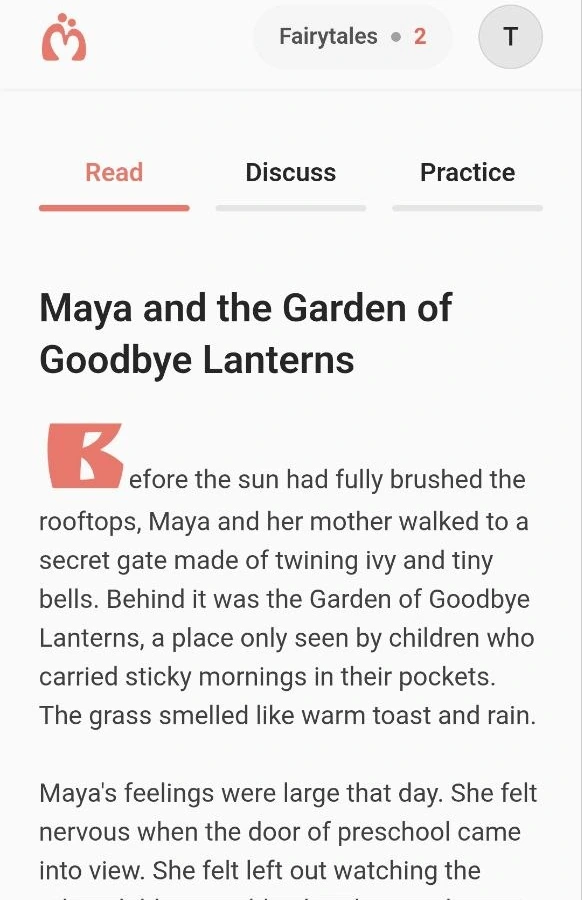
This is Mishami on a phone. The full text of that same story is below, so you can read all of it.
The story
Maya and the Garden of Goodbye Lanterns
Before the sun had fully brushed the rooftops, Maya and her mother walked to a secret gate made of twining ivy and tiny bells. Behind it was the Garden of Goodbye Lanterns, a place only seen by children who carried sticky mornings in their pockets. The grass smelled like warm toast and rain.
Maya's feelings were large that day. She felt nervous when the door of preschool came into view. She felt left out watching the other children tumble ahead. Fox, who wore a scarf with tiny stars, nudged her hand and said, "Lanterns listen if you tell them your small hard things." A unicorn with a soft silver mane nicknamed Sparkle lowered her head and made a little glitter trail across Maya's shoes.
The garden glowed with hundreds of lanterns. Each one hummed a different sound: some purred like kittens, some clicked like tiny clocks. "These lanterns keep see-you-laters," said Fox. "They hold them safe until somebody comes back." Maya reached for a lantern that smelled faintly of orange peel, and it fit her hands exactly.
On the gate hung a riddle, painted on a pebble. Fox read it aloud in a voice like socks on a wooden floor.
"I am carried in a pocket, I am said without sound, I make the leaving softer when I'm given my round. What am I?"
Maya looked at the lantern, then at Sparkle, then at the bells. Then she smiled, because she knew. "A promise," she said. The lantern warmed in her hands and chimed.
"Now the rule of lanterns," said Fox. "A quick goodbye makes them bright. A long one makes them dim. Nobody knows why. It is simply how lanterns are."
So Maya's mother knelt down and held the lantern until it went warm, and said Maya's name into it once, so it would remember her voice. Then came the part they would do every morning after this one. A kiss. A squeeze. And the words: "I always come back."
And then her mother walked.
(Reading pause. Let it be quiet here for a moment.)
The heavy feeling arrived anyway, like a very big invisible backpack. Maya watched the other children tumble ahead through the door, and the left-out feeling came back too, as if everybody else had been handed an easy morning and she had been handed a sticky one.
Sparkle bent her silver head. "Look closer," she said.
And when Maya looked closer she saw it. Every single child going through that door was carrying a lantern. You just cannot see other people's.
Inside the preschool door, a small bridge of stepping-stones led to the classroom, and on the first stone a question was carved. Sparkle nudged her. "You can answer this one with your feet or with your voice."
"Goodbye always goes first. I come after, every time. You cannot see me from the gate, but I am already on my way. What am I?"
Maya's stomach did a funny flip. Then she said it out loud. "The coming back."
She took one careful step. Then another. On the third she set the lantern on the railing and whispered her own promise to it: "I'll come back for you after playtime." The teacher, who smelled like cinnamon, bent down and tucked the lantern's glow safely beside her cubby.
And then a strange thing happened, the way it does. Maya felt two things at the same time: she missed her mother AND she was laughing at Fox, who had got his star scarf caught on a coat hook. Both were real. Both were okay. Her chest went fizzy and bouncy, the proud kind of fizzy, because she had crossed the bridge herself.
Her mother came back right after outdoor time, exactly when she said she would. The lantern chimed a different tune then, a coming-home one. It had kept the promise in its belly all day, like a warm pebble.
Maya's goodbye had not gone anywhere. It had been waiting for her the whole time, in the light.
The conclusion
Maya found out that the hardest part of a goodbye is the gate itself. And the gate is very small. Maya is much bigger than it.
Riddles, woven in
Every story carries riddles the child solves along the way. These are the two from this one.
I am carried in a pocket, I am said without sound, I make the leaving softer when I'm given my round. What am I?
A promise.
If your child pauses, guide them. Ask what people say quietly to themselves when they are going somewhere and will come back.
Goodbye always goes first. I come after, every time. You cannot see me from the gate, but I am already on my way. What am I?
The coming back.
What happens at the end of every single school day.
Discuss
Three questions, in this order, to be asked and not answered for them.
- Fox said a quick goodbye makes a lantern bright and a long one makes it dim. Why do you think that is?
- Sparkle showed Maya that every child was carrying a lantern too, you just can't see them. What do you think is inside the other children's lanterns?
- If you had a lantern to keep your see-you-later in, what would it smell like, and where would you want to leave it during the day?
Tonight's card
This card goes with the story you just read. It is not about making tomorrow morning tear-free. It is about building the goodbye tonight, while everything is calm, so that tomorrow it is short, it is the same, and your child already knows the shape of it.
What's usually going on
A five-year-old who cries at the door and is fine ten minutes later is usually not fighting school. Children this age often start rehearsing the goodbye long before it arrives, because they never know what shape it will take: how long, how many hugs, whether begging works this time. What they are usually asking for is not for you to stay. It is for the goodbye to stop being a negotiation. If that sounds like your mornings, the three steps below are built for exactly that.
What usually doesn't help
Stretching it out. "Okay, one more hug. Okay, last one, I promise." Each extra hug says the door is still open, so a child has to keep pulling on it. Longer goodbyes usually make the crying worse, not better. That is the rule of lanterns in the story, and it is there on purpose.
Arguing them out of the feeling. "But you love school, there's nothing to be scared of." A child will usually push harder to prove the scared thing is real, and now they are fighting you as well as the morning.
Offering an exit or a prize at breakfast. Not "do you want to stay home today?" and not "if you don't cry, we'll get ice cream." The first says crying might reopen the question. The second turns calm into a performance, and when a child can't manage it, the disappointment lands on them.
What you'll need
One small thing that fits in a pocket or sits by the cubby. A smooth stone, a button, a bead, a keyring. If you want the orange-peel part from the story, a scrap of peel in a small pouch works and it smells right. Nothing else.
Three steps for tonight
One. Put the object in their hand and say: "In the story, Maya's mom held the lantern until it was warm and said her name into it, so it would remember her voice. Can I do that with this one?" Hold it, say their name out loud, once, and hand it back warm. Tell them its whole job tomorrow is to keep the see-you-later safe until you come back for them.
Two. Practice the goodbye tonight, at the bedroom door, while nobody is crying. Say: "From tomorrow our goodbye is the same one every morning, so you always know what's coming. A kiss. A squeeze. Then I say I always come back. Then I walk." Do it once, right there. Let them walk through the door. If they want to do it three times and make it silly, do it three times.
Three. Give them the return marker before lights out. Say: "Fox told Maya the coming back was already on its way, even though she couldn't see it from the gate. I'll be at the gate right after outdoor time, same as always." Name a real point in their day that they recognize. Then be there at exactly that point tomorrow. That is the step that does the work: not the promise, the proof.
You know your child best. If tonight needs something different, that is your call to make.
Every story comes with a card like this one.
Free while we're in beta. No app to install, no card required.
Try 3 stories freeMishami is not therapy, does not diagnose or treat any condition, and is not a substitute for professional care. This example was generated by Mishami and the child's details were changed.